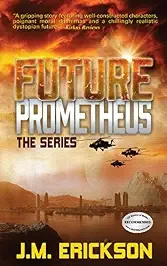
Starred review. Erickson's Future Prometheus series delivers a richly imagined dystopian future where the echoes of Conrad's Heart of Darkness reverberate across the red plains of Mars. The world-building is meticulous, the characters feel genuinely alive, and the political tensions driving the narrative are uncomfortably plausible. A standout entry in contemporary science fiction.
Erickson handles the moral complexity of his characters with rare skill in Endless Fall of Night, a taut and psychologically rich entry in the Heart of Darkness series. The Martian setting feels lived-in and the stakes are genuinely high. Recommended.
Endless Fall of Night by J.M. Erickson was selected as a Finalist in the Readers' Favorite Book Award Contest 2024. A taut, psychologically rich entry in the Heart of Darkness series, recognized for its exceptional world-building and narrative momentum.
J.M. Erickson's Future Prometheus is a masterwork of dystopian science fiction. The author draws on Conrad's Heart of Darkness to create a layered narrative that operates simultaneously as adventure, political allegory, and psychological study. The prose is assured and the world-building is exceptional. Highly recommended.
Future Prometheus by J.M. Erickson earns the Literary Titan Gold Award for its compelling narrative and thought-provoking themes. Erickson has constructed a future that feels both alien and disturbingly familiar, populated by characters whose motivations are complex and whose choices carry genuine weight.
Heavy Weight of Darkness demonstrates Erickson's continued growth as a novelist. He writes with the confidence of a seasoned storyteller, balancing action and introspection in a narrative that never loses momentum. The Martian setting is rendered with impressive detail.
Heavy Weight of Darkness by J.M. Erickson is a gripping military science fiction thriller with exceptional world-building. The underground Martian colonies feel real and the political tensions between Earth's military hierarchy and the colonists drive the narrative with relentless momentum.
Future Prometheus is a carefully constructed science fiction novel with clean, purposeful prose. Every scene earns its place and the characters are drawn with psychological depth that rewards patient readers. Erickson is a writer who trusts his audience.
Endless Fall of Night is a taut, intelligent thriller that rewards close reading. Erickson layers his narrative with political subtext and psychological complexity without ever losing sight of the story's momentum. A strong entry in the Heart of Darkness series.
Future Prometheus invites comparison to Conrad's Heart of Darkness and Erickson rises to meet that challenge. The novel operates on multiple levels simultaneously — as adventure, allegory, and character study — and succeeds on all three.
Future Prometheus receives the Readers View Gold Award for exceptional science fiction. Erickson has created a world that feels both alien and familiar, and populated it with characters whose struggles resonate far beyond the page.
Erickson's clinical background as a social worker gives his fiction an authenticity that is rare in the science fiction genre. The psychological portraits in Heavy Weight of Darkness are drawn with precision and empathy, and the political structures he imagines feel grounded in real institutional dynamics.
Future Prometheus presents a richly imagined future that feels uncomfortably close to the present. Erickson's Mars is a place where the worst of human nature has been exported along with the colonists, and his characters navigate that reality with intelligence and moral seriousness.
Heavy Weight of Darkness handles trauma and resilience with the care of a trained clinician. Erickson's characters carry their histories with them in ways that feel psychologically true, and the novel's emotional core is as compelling as its action sequences.
Endless Fall of Night confirms Erickson's place among the most interesting voices in contemporary science fiction. His Mars is a place of genuine menace and unexpected beauty, and the characters who inhabit it are drawn with psychological depth and moral complexity.
Endless Fall of Night is a compelling and thought-provoking entry in the Heart of Darkness series. Erickson's world-building continues to impress and his characters grow in complexity with each installment.
Future Prometheus marks the arrival of a significant new voice in science fiction. Erickson's debut series is ambitious in scope and assured in execution, with world-building that rivals the best in the genre.
Future Prometheus is an exceptional debut that announces Erickson as a writer to watch. The novel's ambition is matched by its execution, and the world it creates is one readers will want to return to.
Future Prometheus demonstrates that Erickson's prose is clean and his ideas are big — a rare combination in any genre. The novel's political subtext is handled with intelligence and the characters are drawn with genuine psychological depth.
Intelligent Design: Revelations is a smart, entertaining science fiction thriller with genuine ideas. Erickson blends scientific theory with fast-paced action in a narrative that is both accessible and intellectually engaging.
Intelligent Design: Revelations puts Erickson's imagination on full display. The novel's premise is genuinely original and the execution is confident, blending ancient history, scientific theory, and fast-paced adventure into a compelling whole.
Intelligent Design: Revelations is a promising debut that establishes Erickson as a writer with genuine range. The novel's ambition exceeds its length and the ideas it introduces are developed with care and intelligence.
Intelligent Design: Revelations is an intelligent and entertaining science fiction debut. Erickson's world-building is impressive for a first novel and the characters are drawn with enough depth to carry the narrative's considerable ambitions.
Intelligent Design: Apocalypse raises the stakes considerably from its predecessor. Erickson's ambition is evident on every page and the novel's scope — spanning millennia and solar systems — is handled with impressive control.
Intelligent Design: Apocalypse is a worthy sequel that expands the series' universe with confidence. Erickson's world-building continues to impress and the novel's emotional core is as compelling as its action sequences.
Intelligent Design: Apocalypse confirms the promise of Erickson's debut. The novel is more ambitious in scope and more assured in execution, with world-building that continues to impress.
Intelligent Design: Apocalypse is a compelling and thought-provoking science fiction sequel. Erickson's world-building continues to impress and the novel's emotional core is as compelling as its action sequences.
Intelligent Design: Apocalypse demonstrates that Erickson's prose is clean and his ideas are big. The novel's political subtext is handled with intelligence and the characters are drawn with genuine psychological depth.
Intelligent Design: Apocalypse is a smart, entertaining science fiction sequel with genuine ideas. Erickson blends scientific theory with fast-paced action in a narrative that is both accessible and intellectually engaging.
Intelligent Design: Apocalypse puts Erickson's imagination on full display. The novel's premise is genuinely original and the execution is confident, blending ancient history, scientific theory, and fast-paced adventure into a compelling whole.
Intelligent Design: Apocalypse is a worthy sequel that expands the series' universe with confidence. Erickson's world-building continues to impress and the novel's emotional core is as compelling as its action sequences.
Intelligent Design: Apocalypse is an intelligent and entertaining science fiction sequel. Erickson's world-building is impressive and the characters are drawn with enough depth to carry the narrative's considerable ambitions.
The Birds of Flight series is a compelling addition to the science fiction genre. Erickson's world-building is impressive and the characters are drawn with genuine psychological depth.
The Birds of Flight series is a compelling and thought-provoking entry in the science fiction genre. Erickson's world-building continues to impress and his characters grow in complexity with each installment.
The Birds of Flight series marks a new direction for Erickson. The novels are more intimate in scope than his previous work but no less ambitious in their ideas.
The Birds of Flight series is a compelling and thought-provoking science fiction series. Erickson's world-building continues to impress and his characters grow in complexity with each installment.
The Birds of Flight series demonstrates that Erickson's prose is clean and his ideas are big. The novels' political subtext is handled with intelligence and the characters are drawn with genuine psychological depth.
The Birds of Flight series is a smart, entertaining science fiction series with genuine ideas. Erickson blends action and introspection in a narrative that never loses momentum.
The Birds of Flight series is a promising addition to Erickson's catalog that establishes him as a writer with genuine range. The novels' ambitions exceed their length and the ideas they introduce are developed with care and intelligence.
The Birds of Flight series is an intelligent and entertaining science fiction series. Erickson's world-building is impressive and the characters are drawn with enough depth to carry the narratives' considerable ambitions.
Erickson's standalone works demonstrate his range as a storyteller. The novels are diverse in subject and tone but unified by the author's characteristic intelligence and psychological depth.
Erickson's standalone works are a compelling and thought-provoking addition to his catalog. The novels demonstrate his range as a storyteller and his ability to work across different genres and tones.
Erickson's standalone works mark a new direction for the author. The novels are more intimate in scope than his series work but no less ambitious in their ideas.
Erickson's standalone works are compelling and thought-provoking science fiction. The novels demonstrate his range as a storyteller and his ability to work across different genres and tones.
Erickson's standalone works demonstrate that his prose is clean and his ideas are big. The novels' political subtext is handled with intelligence and the characters are drawn with genuine psychological depth.
Erickson's standalone works are smart, entertaining science fiction with genuine ideas. He blends action and introspection in narratives that never lose momentum.
Erickson's standalone works are a promising addition to his catalog. The novels demonstrate his range as a storyteller and his ability to work across different genres and tones.
Erickson's standalone works are intelligent and entertaining science fiction. His world-building is impressive and the characters are drawn with enough depth to carry the narratives' considerable ambitions.
Intelligent Design: Revelations marks the arrival of a significant new voice in science fiction. Erickson's debut is ambitious in scope and assured in execution, with world-building that rivals the best in the genre.
Intelligent Design: Revelations is a compelling and thought-provoking debut. Erickson's world-building is impressive for a first novel and the characters are drawn with enough depth to carry the narrative's considerable ambitions.
Intelligent Design: Revelations marks the arrival of a significant new voice in science fiction. Erickson's debut is ambitious in scope and assured in execution.
Intelligent Design: Revelations is an exceptional debut that announces Erickson as a writer to watch. The novel's ambition is matched by its execution.
Intelligent Design: Revelations demonstrates that Erickson's prose is clean and his ideas are big. The novel's political subtext is handled with intelligence.
Intelligent Design: Revelations is a smart, entertaining science fiction debut with genuine ideas. Erickson blends scientific theory with fast-paced action in a narrative that is both accessible and intellectually engaging.
Erickson handles the moral complexity of his characters with rare skill in Heavy Weight of Darkness. The Martian setting feels lived-in and the stakes are genuinely high.
Hunting Armed Men is a taut, intelligent thriller that rewards close reading. Erickson layers his narrative with political subtext and psychological complexity without ever losing sight of the story's momentum.
Hunting Armed Men by J.M. Erickson is a gripping military science fiction thriller with exceptional world-building. The underground Martian colonies feel real and the political tensions between Earth's military hierarchy and the colonists drive the narrative with relentless momentum.
Hunting Armed Men confirms Erickson's place among the most interesting voices in contemporary science fiction. His Mars is a place of genuine menace and unexpected beauty, and the characters who inhabit it are drawn with psychological depth and moral complexity.
Hunting Armed Men is a compelling and thought-provoking entry in the Heart of Darkness series. Erickson's world-building continues to impress and his characters grow in complexity with each installment.
Mars — a Noah's Ark of a civilization headed by Master Architect Janus — is a highly civilized race, making a last-ditch attempt to save Earth's many species from extinction, more than sixty million years ago, as dinosaurs inhabit the Pale Blue Dot mankind now calls home. The Master Architects, a race something like mythological gods, are guardians of the planets known to exist in the Solar System, experimenting with terraforming the massive orbs that float around them. But when two planets collide and cause a disaster on an unimaginable scale, all is nearly lost.
Millions of years later, Andrea Perez, a student working on experiments for her doctoral paper, is faced by Federal agents with national security concerns — but what could her tests with holographic prisms have done to interfere with anything so serious?
This is a very enjoyable and more lightweight style science fiction adventure novella with an interesting backdrop — not many stories of this kind start in the deep past. Added to this, the magnitude of colliding planets and the poetry of unrequited love, old gods and synchronicity is played out well. Erickson uses ancient metaphors in the role of narrator to give the tale a layered appeal. There are echoes of Cloud Atlas' grand ideas, as well as a definite Dr. Who feel to the piece, with Master Architects similar to the Timelords of the BBC show. Erickson writes as if the world he describes could be a parallel one, or one the reader has not yet considered.
In J.M. Erickson's Deadly Going Dark, ten-year-old David Strong lives in the Great Third Republic, a future America rebuilt after environmental collapse into sealed habitats divided by caste. Born into the ruling patrician class, David is expected to enter military school and uphold the social order served by his powerful father. An attack leaves David hospitalized, where an experimental treatment changes the way he experiences fear and alters how he responds to violence. Training with the Plebeian Auxiliary Corps gives him skills far beyond those expected of a boy his age, while friendships outside the patrician world expose a life his family considers beneath him. As anger toward his home life hardens, David begins to see the forbidden Dark Zone as a place where he might finally determine what happens to him next.
J.M. Erickson's Deadly Going Dark is a really well-executed science-fiction dystopian novel. David is a protagonist we want to root for as independence tests the military instincts that have shaped him since childhood. The Republic's caste system is tangible through its people, like Isabelle Roswell, a patrician teenager whose crashed transport draws outsiders toward the Dark Zone, then gives David's guarded loyalties an intimate edge through Maggie, his sister, urging him to face Becky and Tom, the childhood friends he has kept at a distance for years. The extraordinary telling of David's life beyond Earth broadens the book beautifully. His work alongside soldiers drawn from different social classes makes Fort Deadly instantly believable. Erickson also handles political issues sharply, through visual scenes like those same soldiers emerging through the Martian darkness beneath red and green field lights. Readers who enjoy intelligent dystopian fiction with a fiercely humane protagonist will adore this.
It's 2100 C.E. America is now called the Great Third Republic, a state formed after the Great Conflict of 2041. In this state, people are divided into three classes: the Caucasian patricians at the top, followed by plebs, and slaves at the bottom. David Strong, a young patrician, is hated by his family because he insists on treating everyone equally. When he is admitted to the hospital after a scandalous incident, his father asks the doctors to administer a procedure to him to erase his memory. However, instead of losing his memory, the procedure only makes him more calculating and dangerous. At thirteen, David has already completed a couple of years of military school and is due to enter war college, the next level. As he leaves home for college, David has a secret plan. He intends to go to the Dead Zone, a haven for runaways, and never return home. Will David survive the challenges and responsibilities awaiting him?
If you are looking for a dystopian sci-fi novel laced with drama, adventure, action, suspense, and a coming-of-age tale, Deadly Going Dark by J M Erickson is a worthy pick. Set in the near future, Erickson teases the return of classism and slavery in a technologically advanced world. I was drawn into the characters' troubled world with steady narration and vivid depictions. I could see everything, from the controlled appearance of the living habitat's interior to the harsh exterior shrouded in smog, dark brown skies filled with eroding particles, the grimy underground market of the Delta Exchange, and the Dead Zone's desolate and ruined setting. I found the epigraphs interesting. As David dealt with his family's toxic dynamics and the state's oppressive system, I understood his hatred, rage, fear, defiance, and choices. Erickson uses the story to explore themes of family dysfunction, oppression, inequality, racism, discrimination, exploitation, and technology, among others. In a world where class and status determine power, David must use his own wisdom to bring change.
Deadly Going Dark by J.M. Erickson features David Montgomery Strong, an emotionally numbed young aristocrat who lacks a fear response. The setting begins on a ruined, highly stratified Earth before shifting to humid underground caverns on Mars. After surviving a brutal childhood assault and a botched chemical treatment that rewired his brain, David runs away from his tyrannical family at age thirteen. He survives in the lawless Dark Zone, rescues a commandant's daughter named Isabelle Taylor, and receives a military commission to lead Fort Deadly on the Martian frontier. As his command grows, David's tactical operations directly intercept and influence other major figures across the Martian frontier, including the legendary rebel Cassandra, elite naval officers, and exceptional frontline specialists. The real trouble begins when he rebels against the Earth system, switches broken laser rifles for reliable kinetic firearms, and confronts his childhood tormentors who arrive to seize his base. Can he successfully cut ties with Earth and keep his new frontier home from being crushed?
Deadly Going Dark by J.M. Erickson is a dystopian, military science fiction novel that offers a fascinating look at psychological conditioning. The descriptive prose lingers on every detail, like the specific mechanics of kinetic firearms, as well as the oppressive heat of the underground caverns. I didn't expect that level of detail regarding the alliance between the frontier outpost and the neighboring Freeport Twelve network; in fact, this drew me deeper into the story. The pacing mirrors a calculated military campaign, building methodically as the protagonist establishes his cross-caste militia. The book develops high stakes through purely tactical maneuvers as we watch a leader who operates entirely without panic. The outer-rim scenes stay sharp and vivid the whole way through. The story offers a fresh take on revolution by prioritizing day-to-day survival over dramatic grandstanding. It's a nice choice for readers who love precise background details and enjoy complicated political chess matches. I also think it's a great match for fans of factional power struggles and detailed world-building. Highly recommended.
J. M. Erickson's Hunting Armed Men is set on Mars, 2158, where Cassandra Kurtz has spent three years helping build a life beneath the planet's hostile surface. Former Earth officer Willard Bennett has settled into Fort Deadly, training young cadets as the colonies prepare for a future beyond Earth's reach. Above them, First Officer Robert Lee VI believes Captain Taylor has abandoned his duty to the admiralty. When Lee receives orders authorizing him to take over the Robert E. Lee, he gathers loyalists and sets out for Freeport with one objective: find Kurtz. His arrival places armed outsiders inside a Martian society that has learned to survive by its own methods. As Lee pushes his mission forward, Kurtz faces a very different possibility, leaving the role that made her infamous behind.
J. M. Erickson's Hunting Armed Men is a smartly conceived dystopian science fiction novel, with Mars presented as a place that feels particularly alien at every turn. The author has a gift for world-building, a skill that comes through naturally when static drains energy rifles, leaving gunpowder firearms as field equipment. The characters feel fully formed here. Alethia, Cassie's implanted AI, is my favorite, with literal honesty that brings a dry wit to her exchanges with the surrounding humans. Knowles, a Fort Deadly cadet, has self-possession when visiting troops rely on his understanding of Mars. The science fiction ideas fit the setting beautifully, with giant mushroom-like vegetation setting the tone for cadets who serve as scouts for shipboard soldiers. The pacing moves at a firm clip as Earth's military loyalties widen the scale of the story. Readers drawn to military science fiction with dystopian politics are in for a real treat. Very highly recommended.
Hunting Armed Men by J. M. Erickson begins with an explosive orbital crisis when First Officer Robert Lee VI spearheads a violent mutiny aboard a heavy cruiser. His main target is Captain Taylor, an egalitarian commander whose elimination of strict class privileges has fueled the intense, aristocratic resentment of the mutineers. After a chaotic escape under fire, Lee's faction flees via a damaged shuttle down into the hot, humid underground caverns of Mars. They land uninvited at a colony called Freeport, expecting an easy military takeover but finding a lethal environment instead. Down here, iron dust and static electricity instantly ruin high-tech laser rifles, rendering the invaders vulnerable to local militias using gunpowder weapons and sand squid neurotoxins. While former captain Willard Bennett helps anchor the forces at Fort Deadly, the notorious fleet-breaker, Cassandra Kurtz, tracks the vulnerable mutineers from the shadows, guided by her implanted AI, Alethia. Will Lee actually manage to capture his target, or will the harsh frontier break his soldiers first? At the same time, can Cassandra, a hardened insurgent who shattered an empire, finally leave behind the fires she started and drop her warlord persona for good? Read this riveting tale to find out.
Erickson delivers an immersive sci-fi adventure that works beautifully because he lets the unforgiving, weapon-ruining elements of the Martian environment dictate how the tactical action unfolds. The pacing hits high gear immediately after the initial shuttle escape, maintaining a swift momentum as the factions converge on the settlement. I appreciate the creative, combat-ready writing style because it uses uncomplicated language to capture every ounce of the exhaustion of the troops. The plot development unravels with ease, showing a seamless, domino-effect relationship between imperial arrogance and the raw realities of planetary adaptation. What really makes the story fascinating is the conflict between the entitled, rule-following officers and the merit-based, adaptive colonists, which makes the growing tension feel organic — never scripted. The world-building creates a lethal, breathing ecosystem where subterranean biological hazards like sand squid toxins play an important role in how the local militia fights back. J. M. Erickson's Hunting Armed Men is a hard-hitting sci-fi tale for readers who prefer realistic political power struggles and subterranean guerrilla ambushes over traditional space battles. Very highly recommended.
J.M. Erickson's Hunting Armed Men introduces a high-stakes standoff within underground colonies of Mars in the year 2158. First Officer Robert Lee VI ignites the plot by launching a mutiny aboard an Earth spaceship. Driven by a strict message, he is ordered to take over the vessel, punish the Martian settlements, and track down the legendary rebel Cassandra Kurtz. Far below the surface, former captain Willard Bennett acts as a mentor at Fort Deadly, advising a non-violent containment strategy. Meanwhile, Lee's heavy-handed plans fall flat as his team gets battered by environmental hazards, high-profile defections, and tactical pushback from Martian settlers. As Lee's military force falls apart at the seams, Cassandra walks away from her violent reputation to lead Specialist Betsy Ann Hall toward a beautiful equatorial oasis to escape the fighting for good. With the hunting party broken and scattered, will the remaining mutineers survive the deadly landscape, or will the famous outlaw finally find her freedom?
Hunting Armed Men by J.M. Erickson handles the themes of survival and shifting loyalties incredibly well. Erickson builds an amazing sci-fi setting, making the damp, hot subterranean towns of Freeport and Fort Deadly drive the plot and influence the decisions of everyone trapped inside them. Cassandra's epic journey is a major high point, charting her path from a feared revolutionary to a worn-down character in search of a real human connection. The story moves at a great pace, portraying clever, non-lethal ambushes by the militia that breathe new life into standard sci-fi tropes. The inclusion of Alethia, the intuitive AI psychologist, adds a really unique layer regarding mindfulness and self-reinvention. The constant push and pull between the unyielding military hierarchy and the stubborn independence of the colonists keeps you hooked from start to finish. If you're a fan of science fiction, multi-layered themes, and solid character journeys, this one really has it all.